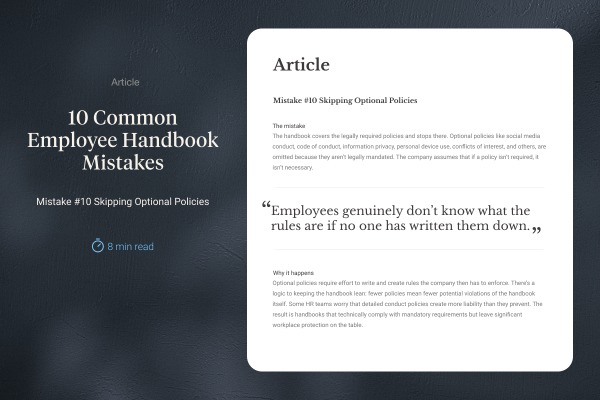
10 Common Employee Handbook Mistakes: #6 The Annual Review Problem
Handbook compliance requires continuous monitoring, not annual checkpoints.
Your employee handbook is the foundation of your employment relationship. It communicates expectations, establishes legal protections, and documents the policies your company lives by. Done well, it protects your organization from the legal claims, disputes, and compliance failures that cost companies millions of dollars every year. Done poorly or not done at all, it creates the very exposure it was meant to prevent.
Most handbook mistakes aren’t obvious. They don’t look like mistakes. They look like a signed acknowledgment page, an annual review process, a thoughtfully downloaded template, or a conveniently short document that doesn’t burden employees with too much to read. The problem is that each of these common practices leaves companies legally exposed in ways that only surface when something goes wrong.
Here is the sixth of the ten most common employee handbook mistakes, what they are, why they happen, what they actually cost, and how to fix them.
Mistake #6: The Annual Review Problem
The mistake
The company schedules an annual handbook review, typically at the start of the year, updates what needs updating, redistributes the revised document, and considers compliance maintained for another twelve months. This feels like a responsible process. It isn’t.
Why it happens
Annual reviews are easy to schedule, easy to track, and feel appropriately thorough. They fit neatly into a calendar and give HR a clear milestone to plan around. The assumption built into the process is that employment law changes slowly enough that once-a-year is sufficient. That assumption has not been accurate for years.
The real risk
There were more than 10,000 employment law changes across the United States in 2025 alone. State legislatures pass new requirements, effective dates arrive mid-year, regulatory agencies issue updated guidance, and court decisions reshape how existing laws are interpreted, all on a continuous basis that has nothing to do with your review schedule.
Non-compliance begins on the effective date of a new law, not on the date you discover it. A California sick leave amendment that takes effect in July creates a compliance gap from July forward, whether or not your annual review is scheduled for December. An employee who files a wage claim in September doesn’t wait for your review cycle to complete before asserting their rights.
Waiting until the end of the year to address mid-year law changes means months of exposure on every new requirement that took effect in the interim. For companies operating in multiple states, those months of exposure multiply across every jurisdiction where a change occurred.
The fix
Handbook compliance requires continuous monitoring, not annual checkpoints. When a state amends an employment law, the affected policy needs to be updated before the effective date and employees need to receive and acknowledge the updated version promptly.
SecuraHR monitors employment law changes across all 50 states and localities continuously. When a change occurs, SecuraHR’s legal team reviews it, updates the affected policy language, and the platform notifies you so you can push the update to affected employees immediately. You don’t need to track state legislative calendars or monitor regulatory agency announcements. The platform does it, and you act when it matters, not months later.
The common thread
These ten mistakes share a root cause: treating the employee handbook as a one-time administrative task rather than a living compliance document. Handbooks get written, distributed, and filed and then they sit unchanged while employment laws evolve, workforces expand into new states, and workplace conduct issues arise that no one thought to address in writing.
The companies that avoid these mistakes treat their handbooks the way they treat other compliance infrastructure: as something that requires the right foundation, continuous maintenance, a proper delivery process, and a complete record of who received what and when. That approach isn’t more complicated than what most companies are doing today. It’s just more deliberate and it pays for itself the first time it prevents a claim from succeeding.
How to build handbooks that don’t make these mistakes
SecuraHR generates attorney-drafted, state-specific employee handbooks for every state where your employees work, with integrated video presentations, policy-level acknowledgment tracking, a complete digital audit trail, and continuous legal monitoring that keeps every policy current as laws change.
Get started at www.securahr.com