Move HR Compliance at the Speed of AI
AI changes the equation — but only when it’s built on the right foundation.
Employment law doesn’t slow down. It doesn’t pause for your annual review. It doesn’t wait for your HR team to catch up.
It changes. Constantly. And every change creates a gap between what your policies say and what the law requires.
That gap is where liability lives.
The Old Way.
For decades, HR compliance operated on a calendar. Laws changed. HR teams found out eventually. Policies got updated — months later, sometimes longer. Handbooks went out once a year. Employees signed something. The file got stored somewhere.
It worked well enough when the law moved slowly.
The law no longer moves slowly.
In 2025 alone, there were over 10,000 employment law changes across federal, state, and local jurisdictions. New leave requirements. Updated wage rules. Revised training mandates. City ordinances that took effect the day they were signed.
None of them waited for anyone’s annual review cycle.
The Issue Isn’t Effort. It’s Infrastructure.
HR teams are not the problem. The volume is.
Monitoring every federal requirement, all 50 states, and thousands of local jurisdictions — continuously, in real time — while also running the day-to-day business of HR is not a reasonable ask of any team. And yet that’s exactly what compliance requires.
The hours spent tracking legislative updates. Cross-referencing with outside counsel. Verifying whether a new law applies and when it takes effect. Identifying which policies need to change and making sure the right employees receive them in time.
That work is necessary. It is also enormously time-consuming — and it pulls HR professionals away from the work that actually requires their expertise.
The answer is not more diligence. The answer is a system that handles the tracking, the updating, and the delivery automatically — so HR teams can focus on what only they can do.
The 2% Problem.
AI changes the equation — but only when it’s built on the right foundation.
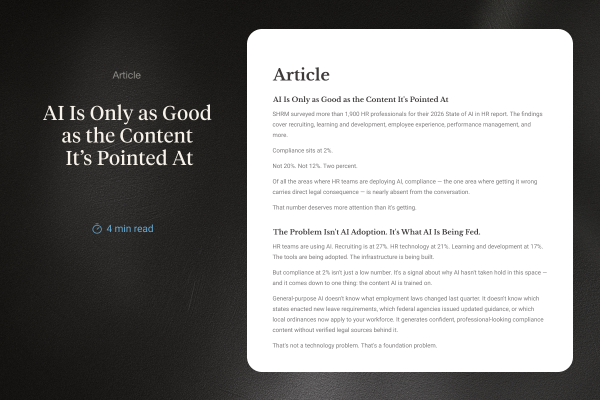
According to SHRM’s 2026 State of AI in HR report, which surveyed more than 1,900 HR professionals, only 2% of organizations are using AI for HR compliance. That number sits at the very bottom of every HR function measured — below recruiting, learning and development, performance management, and nearly every other area of HR.
That’s not a coincidence. It’s a signal.
The reason AI hasn’t taken hold in compliance isn’t that HR teams aren’t interested. It’s that most AI tools aren’t built for it. General-purpose AI doesn’t know what employment laws changed last quarter. It doesn’t know which states enacted new leave requirements, which federal agencies issued updated guidance, or which local ordinances now apply to a specific workforce. It generates confident, professional-looking compliance content without verified legal sources behind it.
And it will never tell you when it’s wrong.
That’s not a technology problem. That’s a foundation problem. And it’s exactly why compliance sits at 2% while every other HR function has moved further ahead.
The Foundation Changes Everything.
Compliance-grade AI requires something fundamentally different. Not web content. Not general training data. Actual statutes, regulations, and agency guidance — the law itself, continuously updated as it changes, applied automatically to the right policies, the right employees, and the right jurisdictions the moment something shifts.
When the source is verified, the output is trusted. HR teams stop cross-referencing. They stop calling outside counsel to confirm what a new regulation means. They stop wondering whether what the AI generated reflects what the law actually requires today.
They already know it does.
This is what compliance-grade AI actually delivers — not just faster answers, but answers you can act on. A trusted source that knows every law, every jurisdiction, every requirement. One that updates automatically when something changes. One that tells the right employees what they need to know before the gap opens, not after it’s discovered.
What Speed Actually Looks Like.
Every employment law across every federal, state, and local jurisdiction — monitored continuously. When a court ruling becomes law, the system reflects it. When a new law takes effect, the handbook updates. When a policy changes, the right employees are notified, prompted to re-read it, and asked to acknowledge it. New policies get added. Required trainings get assigned. Procedures get updated. Everything is documented — automatically, completely, and in real time.
What used to take hours of research, days of drafting, and weeks of follow-up now takes minutes.
The organizations that crack this — that find AI built on the right foundation — will move compliance from the bottom of the adoption curve to the center of their HR strategy. Not because they worked harder. Because the system does the work.
That’s what compliance at the speed of AI actually means. Not a better dashboard. Not a smarter alert. A system that moves the moment the law moves — and leaves nothing behind.
Compliance at the speed of AI isn’t a future state. It’s already possible. The only question is whether the AI you’re using is built for the job.