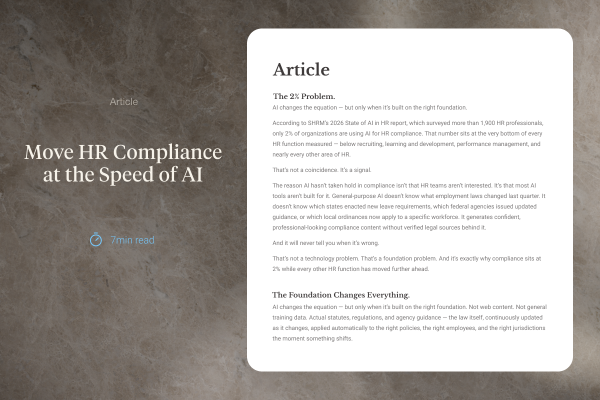
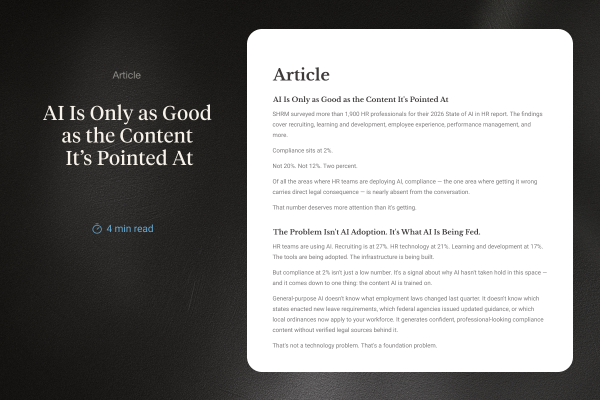
Beyond the Chatbot: How SecuraAI Delivers AI That Actually Knows HR Compliance
Why connecting AI to a purpose-built SaaS platform, with lawyer-reviewed content already inside, produces a fundamentally different (and better) outcome.
The artificial intelligence conversation has moved fast. Just a few years ago, large language models were a novelty. Today, as MIT Sloan professor Sinan Aral told MIT Sloan Management Review, “The agentic AI age is already here. We have agents deployed at scale in the economy to perform all kinds of tasks.”
But here’s the question most organizations haven’t fully answered yet: not all AI is equal. A general-purpose chatbot and an AI system purpose-built on top of a specialized platform with curated, legally reviewed content are not the same tool, not even close.
SecuraHR’s SecuraAI is a clear example of why the difference matters enormously, especially in a domain as high-stakes as human resources and employment law.
What Kind of AI is SecuraAI?
SecuraAI is not one type of AI; it is several, working in concert.
At its most visible layer, SecuraAI is a conversational AI: a natural language interface that allows HR professionals, managers, and employees to ask questions, request documents, and navigate complex HR processes the way they would talk to a knowledgeable colleague. No dropdown menus. No searching through policy PDFs. fJust a question and a precise, contextual answer.
Beneath that conversational layer lives an expert system, a rules-based AI architecture that encodes deep domain knowledge. When SecuraAI helps create an employee handbook, generate a handbook presentation, or produce plain-English video explanations of company policies, it is drawing on structured logic built from actual HR expertise and employment law, not pattern-matching against the open internet.
And woven through the entire platform is an agentic AI capability, the ability to execute multi-step workflows autonomously. SecuraAI doesn’t just answer a question about a policy; it can create the handbook, build the presentation, generate the explanatory video, distribute the content to employees, and then track who has read, viewed, acknowledged, or signed it, all as a connected, automated workflow.
This combination places SecuraAI squarely in what MIT Sloan researchers define as the most powerful class of AI systems: those that “execute multi-step plans, use external tools, and interact with digital environments to function as powerful components within larger workflows.”
The Platform Advantage: Why Connected AI Wins
Here is the insight most AI coverage misses: the intelligence of an AI system is only as good as the context it operates within.
A general-purpose large language model trained on internet data knows a lot of things about a lot of topics, including HR. But it doesn’t know your company’s policies. It doesn’t know which state your employees work in, which jurisdiction’s leave laws apply, or whether your handbook was last updated before or after a major regulatory change. It guesses, interpolates, and sometimes hallucinates with remarkable confidence.
SecuraAI is different because it operates inside SecuraHR, a purpose-built HR SaaS platform. The AI isn’t reaching out to the open web for answers. It is working with structured, platform-native data: your actual company information, your real employee records, your specific policies, your compliance tracking history.
The MIT Sloan research makes this point indirectly when describing why AI agents add the most value in situations involving “information asymmetries,” contexts where the AI has access to more relevant, organized data than a human could efficiently process. In SecuraHR, that information asymmetry is engineered by design. The platform is the curated data environment that makes the AI’s outputs reliable.
This is the difference between asking a brilliant generalist a complex HR question and asking your employment attorney who has spent years learning your business. Same intelligence level, radically different answer quality.
The Content Advantage: Lawyer-Reviewed Before the AI Touches It
If the platform connection is SecuraAI’s structural advantage, the pre-curated, attorney-reviewed content library is its knowledge advantage.
Most AI tools used for HR tasks are working upstream from the content. They help create HR documents, policies, and handbooks from scratch, which means they are generating legal language, employment policies, and compliance frameworks on the fly, without any guarantee that the output reflects current law, is appropriate for a specific jurisdiction, or would hold up to scrutiny.
SecuraHR inverts this model entirely.
The employment laws, HR content frameworks, policy templates, and compliance requirements inside SecuraHR have already been gathered, authored, and reviewed by employment lawyers before SecuraAI ever works with them. The AI’s job is not to invent HR law, it is to apply pre-validated, expert-reviewed content intelligently to each organization’s specific situation.
This matters more than it might initially seem. As MIT Sloan research on agentic AI warns, “A rogue AI agent deciding to reject a mortgage loan or college admissions decision based on faulty information can do just as much damage, or more, than simple hallucinations.” In HR, the equivalent risks are real: a policy that violates state law, a handbook clause that creates employer liability, a compliance process that doesn’t actually satisfy a regulatory requirement. These aren’t hypothetical risks, they are the kinds of mistakes that generate lawsuits.
Pre-reviewed content transforms SecuraAI from a tool that generates HR content into a tool that delivers HR content that has already been validated. The AI applies the intelligence. The lawyers have already done the legal work.
Result as a Service: A New Way to Think About AI Value
There is a useful concept emerging in how leading organizations think about AI deployment: Result as a Service (RaaS).
Traditional software delivers tools. Traditional AI delivers capabilities. But what organizations actually need and what SecuraAI delivers is outcomes or results: a compliant, up-to-date employee handbook; a clear, plain-English policy presentation with video explanations employees will actually watch; a documented trail of who has acknowledged what, and when.
The MIT Sloan research framed the core economic promise of AI agents this way: the ability to “dramatically reduce transaction costs, the time and effort involved in searching, communicating, and contracting.” SecuraAI does exactly this, but it goes further. It doesn’t just reduce the effort of creating HR content, it packages the entire lifecycle, from content creation through employee acknowledgment and compliance tracking, into a managed, intelligent workflow.
This is the Result as a Service model in action:
- Input: Your company’s information, employee roster, and locations
- Process: SecuraAI applies lawyer-reviewed content templates, generates handbook and policy materials, produces plain-English explanations, distributes to employees, and tracks compliance
- Output: A documented, compliant HR program, not a draft to be reviewed, but a finished result
For HR teams managing compliance across multiple states, complex workforces, or rapid growth, this shift from tool to outcome is transformative.
The Governance Piece: Built-In, Not Bolted On
One of the most important cautions in the MIT Sloan research on agentic AI is around governance. “As you move agency from humans to machines, there’s a real increase in the importance of governance and infrastructure to control and support agentic systems,” MIT Sloan professor Kate Kellogg observed.
This is where SecuraAI’s compliance tracking capability becomes a governance feature, not just a convenience. When SecuraAI tracks whether an employee has read, viewed, acknowledged, or signed a piece of HR content, it is creating an auditable record, the kind of documentation that protects organizations in disputes, audits, and regulatory inquiries.
The governance isn’t something HR teams have to build separately. It is a native output of the platform. Every policy distributed, every acknowledgment received, every training viewed is tracked, timestamped, and reportable. The AI doesn’t just automate HR work, it documents that the HR work was done.
The Bigger Picture
The MIT Sloan article declares that every organization needs “a strategy to deploy and utilize agents in customer-facing and internal use cases.” For HR leaders, SecuraAI represents what that strategy looks like when it’s built correctly from the start: AI that is connected to the platform where the work actually happens, grounded in content that has already been validated by experts, and designed to deliver complete outcomes rather than partial assistance.
The question for most AI implementations is: how do we trust it? SecuraAI answers that question by design, with platform-native data, lawyer-reviewed content, and a Result as a Service model that delivers not just intelligence, but accountable, documented outcomes.
In a domain where getting it wrong carries real legal and human consequences, that’s not a small thing. That’s the whole point.
SecuraHR’s SecuraAI is purpose-built for HR compliance, handbook creation, employee communication, and compliance tracking, bringing together conversational AI, expert systems, and agentic automation on a single integrated platform.