10 Common Employee Handbook Mistakes: #1 Collecting Signature Pages Instead of Policy-Level Acknowledgments
Done well, it protects your organization from the legal claims, disputes, and compliance failures that cost companies millions of dollars every year. Done poorly or not done at all, it creates the very exposure it was meant to prevent.
Your employee handbook is the foundation of your employment relationship. It communicates expectations, establishes legal protections, and documents the policies your company lives by. Done well, it protects your organization from the legal claims, disputes, and compliance failures that cost companies millions of dollars every year. Done poorly or not done at all, it creates the very exposure it was meant to prevent.
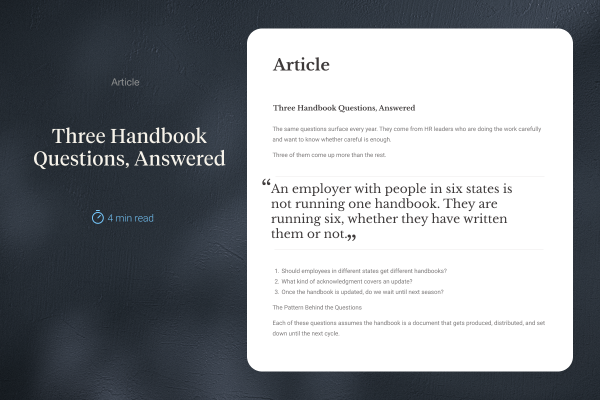
Most handbook mistakes aren’t obvious. They don’t look like mistakes. They look like a signed acknowledgment page, an annual review process, a thoughtfully downloaded template, or a conveniently short document that doesn’t burden employees with too much to read. The problem is that each of these common practices leaves companies legally exposed in ways that only surface when something goes wrong.
Here is the first of the ten most common employee handbook mistakes, what they are, why they happen, what they actually cost, and how to fix them.
Mistake #1: Collecting signature pages instead of policy-level acknowledgments
The mistake
The employee gets a handbook, signs a page at the back confirming they received it, and the signed page goes in their file. HR considers the box checked. This is the standard practice at the majority of companies and it provides far less legal protection than most HR teams realize.
Why it happens
A single signature page is simple to administer and feels sufficient. The employee signed something. There’s a record. What more is needed? The answer is proof of policy level understanding and this proof is exactly what a single signature page cannot provide.
The real risk
In over 16,000 court cases, judges have asked whether an employee read and understood a specific policy. Courts have ruled that a single signature page was not enough to prove understanding or use the policy as a defense.
A whole-handbook signature confirms only one thing: the employee received the document. It does not confirm that the employee read the harassment reporting policy. It does not confirm they understood the at-will employment clause. It does not confirm they acknowledged the confidentiality agreement or the social media policy. When a harassment claim arises and the question is whether the employee knew how to report it, “they signed the handbook” is a weak answer. When a wrongful termination dispute turns on whether the employee understood the at-will relationship, a general receipt acknowledgment is thin evidence.
Courts and investigators look for specific evidence that employees understood specific policies. A general signature page cannot provide that.
The fix
Policy-level acknowledgments require employees to sign off individually on every policy: the harassment prevention policy, the at-will employment statement, the confidentiality agreement, the technology use policy, and any other policies where “I didn’t know” is a defense an employee might actually use. Each sign-off creates a specific, dated record tied to a specific policy version.
SecuraHR tracks acknowledgments digitally at both the handbook level and the individual policy level, by employee, policy, version, and date. When a dispute arises, you can produce an exact record of which employee acknowledged which policy and when. That specificity is what actually holds up in court.
The common thread
These ten mistakes share a root cause: treating the employee handbook as a one-time administrative task rather than a living compliance document. Handbooks get written, distributed, and filed and then they sit unchanged while employment laws evolve, workforces expand into new states, and workplace conduct issues arise that no one thought to address in writing.
The companies that avoid these mistakes treat their handbooks the way they treat other compliance infrastructure: as something that requires the right foundation, continuous maintenance, a proper delivery process, and a complete record of who received what and when. That approach isn’t more complicated than what most companies are doing today. It’s just more deliberate and it pays for itself the first time it prevents a claim from succeeding.
How to build handbooks that don’t make these mistakes
SecuraHR generates attorney-drafted, state-specific employee handbooks for every state where your employees work, with integrated video presentations, policy-level acknowledgment tracking, a complete digital audit trail, and continuous legal monitoring that keeps every policy current as laws change.
Get started at www.securahr.com