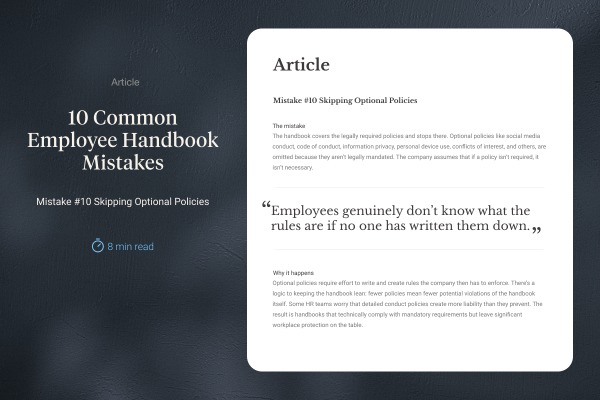
10 Common Employee Handbook Mistakes: #2 Distributing Handbooks Without Video Presentations
The goal isn’t just compliance on paper. It’s genuine employee understanding that holds up when it’s challenged. No other handbook platform offers this capability in the same integrated, trackable way.
Your employee handbook is the foundation of your employment relationship. It communicates expectations, establishes legal protections, and documents the policies your company lives by. Done well, it protects your organization from the legal claims, disputes, and compliance failures that cost companies millions of dollars every year. Done poorly or not done at all, it creates the very exposure it was meant to prevent.
Most handbook mistakes aren’t obvious. They don’t look like mistakes. They look like a signed acknowledgment page, an annual review process, a thoughtfully downloaded template, or a conveniently short document that doesn’t burden employees with too much to read. The problem is that each of these common practices leaves companies legally exposed in ways that only surface when something goes wrong.
Here is the second of the ten most common employee handbook mistakes, what they are, why they happen, what they actually cost, and how to fix them.
Mistake #2: Distributing handbooks without video presentations
The mistake
The handbook gets emailed, handed over in an onboarding packet, or posted to a portal. Employees are told to read it and sign. Most don’t read it carefully. Some don’t read it at all. HR has a signature on file and assumes the communication is complete.
Why it happens
Presentations take time and resources to produce. For most companies, getting the handbook written and distributed already feels like enough. A presentation feels like extra work on top of an already finished task. So it gets skipped.
The real risk
Policy language is often dense, technical, and written to satisfy legal requirements rather than to communicate clearly. Courts have increasingly questioned whether employees can genuinely understand what they are agreeing to when they sign a handbook. If a judge or jury finds that a policy was written in a way that a reasonable employee could not be expected to understand, the acknowledgment loses much of its value and the company loses the protection it was counting on.
This is not a hypothetical concern. Employment litigation regularly turns on whether employees truly understood a policy, not just whether they signed a form saying they received it. The exposure is real, and it exists even when every signature page is in order.
The fix
Video presentations solve the understanding problem that written distribution alone cannot. A well-produced handbook presentation walks employees through each key policy in plain, conversational language, the kind of language that people can actually absorb and remember. Employees watch it, understand it, and come away genuinely knowing what the policies require of them and what protections they have.
This matters in court. A company that can show employees watched a presentation explaining the harassment reporting policy is in a fundamentally stronger position than one that can only show a signature on a packet of dense legal language.
SecuraHR’s Handbook Presentations™ are built specifically for this purpose. They are designed to be clear, engaging, and easy to understand because the goal isn’t just compliance on paper. It’s genuine employee understanding that holds up when it’s challenged. No other handbook platform offers this capability in the same integrated, trackable way.
The common thread
These ten mistakes share a root cause: treating the employee handbook as a one-time administrative task rather than a living compliance document. Handbooks get written, distributed, and filed and then they sit unchanged while employment laws evolve, workforces expand into new states, and workplace conduct issues arise that no one thought to address in writing.
The companies that avoid these mistakes treat their handbooks the way they treat other compliance infrastructure: as something that requires the right foundation, continuous maintenance, a proper delivery process, and a complete record of who received what and when. That approach isn’t more complicated than what most companies are doing today. It’s just more deliberate and it pays for itself the first time it prevents a claim from succeeding.
How to build handbooks that don’t make these mistakes
SecuraHR generates attorney-drafted, state-specific employee handbooks for every state where your employees work, with integrated video presentations, policy-level acknowledgment tracking, a complete digital audit trail, and continuous legal monitoring that keeps every policy current as laws change.
Get started at www.securahr.com