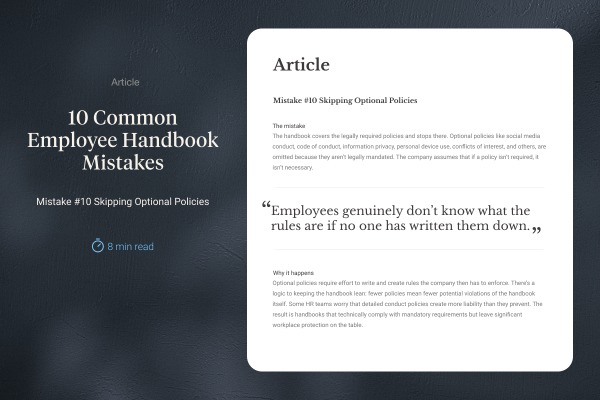
10 Common Employee Handbook Mistakes: #3 Using AI-Generated or Downloaded Policy Templates
There were over 10,000 employment law updates in 2025. A template from 2023 or 2024 almost certainly contains provisions that are now outdated, missing state-specific requirements that have since been changed.
Your employee handbook is the foundation of your employment relationship. It communicates expectations, establishes legal protections, and documents the policies your company lives by. Done well, it protects your organization from the legal claims, disputes, and compliance failures that cost companies millions of dollars every year. Done poorly or not done at all, it creates the very exposure it was meant to prevent.
Most handbook mistakes aren’t obvious. They don’t look like mistakes. They look like a signed acknowledgment page, an annual review process, a thoughtfully downloaded template, or a conveniently short document that doesn’t burden employees with too much to read. The problem is that each of these common practices leaves companies legally exposed in ways that only surface when something goes wrong.
Here is the third of the ten most common employee handbook mistakes, what they are, why they happen, what they actually cost, and how to fix them.
Mistake #3: Using AI-generated or downloaded policy templates
The mistake
An HR manager searches for a handbook template, downloads one from an HR website, or prompts an AI writing tool to generate policy language. The output looks professional and covers the right topics. It gets customized with the company name and a few details, and becomes the official employee handbook.
Why it happens
Templates and AI tools are fast, free or cheap, and produce output that looks exactly like what a handbook is supposed to look like. For a time-pressed HR team without a dedicated employment attorney on staff, they feel like a reasonable solution.
The real risk
Looking right and being right are two different things and in employment law, the difference is what matters. Downloaded templates reflect what the law said when they were written, which may have been years ago. Employment law changes constantly. There were over 10,000 employment law updates in 2025. A template from 2023 or 2024 almost certainly contains provisions that are now outdated, missing state-specific requirements that have since been changed.
AI-generated content is worse, not better. General-purpose AI tools generate fluent, confident policy language without verified legal sources behind it. They cannot confirm whether their output reflects current federal, state, or local employment laws.
They cannot flag that California amended its sick leave law last quarter or that New York updated its harassment policy requirements. The output sounds authoritative even when the underlying legal substance is incomplete, outdated, or fabricated. HR teams often don’t discover the error until there’s a claim, at which point the confidently wrong policy has already been distributed to every employee.
The fix
Every policy in a compliant handbook should be authored and reviewed by employment attorneys with jurisdiction-specific expertise. This isn’t about being overly cautious, it’s about the basic requirement that legal documents reflect current law. Attorney-authored content built on a continuously monitored legal database is the only format that can reliably deliver that.
SecuraHR’s handbook policies are written and reviewed by employment attorneys. When states amend their laws, SecuraHR’s legal team reviews the change and updates the affected policy language. The platform reflects current law, not what the law said when a template was last edited or what an AI model generated from a training dataset with an unknown cutoff date.
The common thread
These ten mistakes share a root cause: treating the employee handbook as a one-time administrative task rather than a living compliance document. Handbooks get written, distributed, and filed and then they sit unchanged while employment laws evolve, workforces expand into new states, and workplace conduct issues arise that no one thought to address in writing.
The companies that avoid these mistakes treat their handbooks the way they treat other compliance infrastructure: as something that requires the right foundation, continuous maintenance, a proper delivery process, and a complete record of who received what and when. That approach isn’t more complicated than what most companies are doing today. It’s just more deliberate and it pays for itself the first time it prevents a claim from succeeding.
How to build handbooks that don’t make these mistakes
SecuraHR generates attorney-drafted, state-specific employee handbooks for every state where your employees work, with integrated video presentations, policy-level acknowledgment tracking, a complete digital audit trail, and continuous legal monitoring that keeps every policy current as laws change.
Get started at www.securahr.com