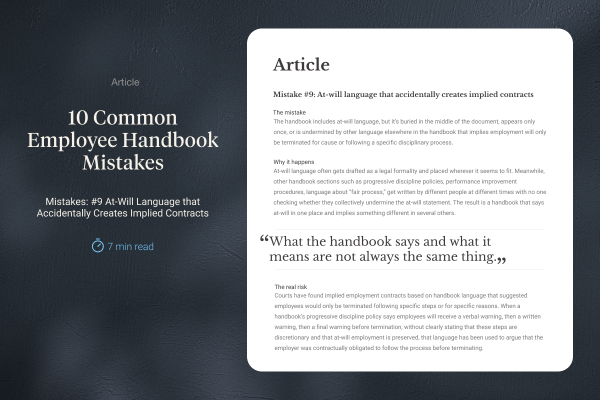
10 Common Employee Handbook Mistakes: #10 Skipping Optional Policies
Employees genuinely don’t know what the rules are if no one has written them down.
Your employee handbook is the foundation of your employment relationship. It communicates expectations, establishes legal protections, and documents the policies your company lives by. Done well, it protects your organization from the legal claims, disputes, and compliance failures that cost companies millions of dollars every year. Done poorly or not done at all, it creates the very exposure it was meant to prevent.
Most handbook mistakes aren’t obvious. They don’t look like mistakes. They look like a signed acknowledgment page, an annual review process, a thoughtfully downloaded template, or a conveniently short document that doesn’t burden employees with too much to read. The problem is that each of these common practices leaves companies legally exposed in ways that only surface when something goes wrong.
Here is the tenth of the ten most common employee handbook mistakes, what they are, why they happen, what they actually cost, and how to fix them.
Mistake #10: Skipping optional policies
The mistake
The handbook covers the legally required policies and stops there. Optional policies like social media conduct, code of conduct, information privacy, personal device use, conflicts of interest, and others, are omitted because they aren’t legally mandated. The company assumes that if a policy isn’t required, it isn’t necessary.
Why it happens
Optional policies require effort to write and create rules the company then has to enforce. There’s a logic to keeping the handbook lean: fewer policies mean fewer potential violations of the handbook itself. Some HR teams worry that detailed conduct policies create more liability than they prevent. The result is handbooks that technically comply with mandatory requirements but leave significant workplace protection on the table.
The real risk
Optional policies exist to close the “I didn’t know” gap. Without a social media policy, an employee who posts confidential company information publicly can claim they didn’t know it was prohibited. Without a code of conduct, an employee terminated for behavior that fell short of legal but violated reasonable workplace standards can argue the expectation was never communicated. Without an information privacy policy, an employee who mishandles sensitive customer or company data has a credible defense that no one told them the rules.
The “I didn’t know” defense is remarkably effective when it’s true. Employees genuinely don’t know what the rules are if no one has written them down. Optional policies aren’t optional in any meaningful practical sense, they are the mechanism by which companies communicate standards of conduct that courts and arbitrators will hold employees to.
The policies that matter most and are most commonly omitted include:
- Social media policy: defines appropriate and prohibited use of social media in ways that affect the company, its clients, and colleagues.
- Code of conduct: establishes behavioral expectations that go beyond specific legal prohibitions such as professionalism, respect, conflict resolution, and the standards by which employment decisions will be made.
- Information and data privacy: specifies how employees must handle confidential company information, customer data, and proprietary materials.
- Personal device and technology use: addresses BYOD policies, company equipment use, and the boundaries between personal and professional use of technology at work.
- Conflicts of interest: requires employees to disclose outside business activities, personal relationships that affect work decisions, and financial interests that could compromise their judgment.
The fix
Optional policies should be understood as protective policies, protections for the company, protections for employees, and the documented foundation for consistent enforcement of workplace standards. A handbook that includes only mandatory policies is a handbook that leaves a company exposed every time an employee does something problematic that the handbook didn’t explicitly address.
SecuraHR’s handbook platform includes a full library of optional policies, each attorney-reviewed and written to be clear and enforceable. The platform makes it straightforward to include the policies that fit your workplace, so that when conduct issues arise, you have documented standards to point to and employees have no credible claim they didn’t know.
The common thread
These ten mistakes share a root cause: treating the employee handbook as a one-time administrative task rather than a living compliance document. Handbooks get written, distributed, and filed and then they sit unchanged while employment laws evolve, workforces expand into new states, and workplace conduct issues arise that no one thought to address in writing.
The companies that avoid these mistakes treat their handbooks the way they treat other compliance infrastructure: as something that requires the right foundation, continuous maintenance, a proper delivery process, and a complete record of who received what and when. That approach isn’t more complicated than what most companies are doing today. It’s just more deliberate and it pays for itself the first time it prevents a claim from succeeding.
How to build handbooks that don’t make these mistakes
SecuraHR generates attorney-drafted, state-specific employee handbooks for every state where your employees work, with integrated video presentations, policy-level acknowledgment tracking, a complete digital audit trail, and continuous legal monitoring that keeps every policy current as laws change.
Get started at www.securahr.com