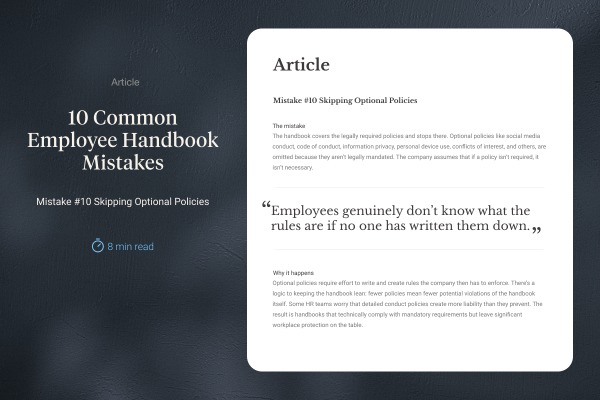
10 Common Employee Handbook Mistakes: #9 At-Will Language that Accidentally Creates Implied Contracts
What the handbook says and what it means are not always the same thing.
Your employee handbook is the foundation of your employment relationship. It communicates expectations, establishes legal protections, and documents the policies your company lives by. Done well, it protects your organization from the legal claims, disputes, and compliance failures that cost companies millions of dollars every year. Done poorly or not done at all, it creates the very exposure it was meant to prevent.
Most handbook mistakes aren’t obvious. They don’t look like mistakes. They look like a signed acknowledgment page, an annual review process, a thoughtfully downloaded template, or a conveniently short document that doesn’t burden employees with too much to read. The problem is that each of these common practices leaves companies legally exposed in ways that only surface when something goes wrong.
Here is the ninth of the ten most common employee handbook mistakes, what they are, why they happen, what they actually cost, and how to fix them.
Mistake #9: At-will language that accidentally creates implied contracts
The mistake
The handbook includes at-will language, but it’s buried in the middle of the document, appears only once, or is undermined by other language elsewhere in the handbook that implies employment will only be terminated for cause or following a specific disciplinary process.
Why it happens
At-will language often gets drafted as a legal formality and placed wherever it seems to fit. Meanwhile, other handbook sections such as progressive discipline policies, performance improvement procedures, language about “fair process,” get written by different people at different times with no one checking whether they collectively undermine the at-will statement. The result is a handbook that says at-will in one place and implies something different in several others.
The real risk
Courts have found implied employment contracts based on handbook language that suggested employees would only be terminated following specific steps or for specific reasons. When a handbook’s progressive discipline policy says employees will receive a verbal warning, then a written warning, then a final warning before termination, without clearly stating that these steps are discretionary and that at-will employment is preserved, that language has been used to argue that the employer was contractually obligated to follow the process before terminating.
The at-will doctrine is the foundational protection for employer flexibility in employment decisions. Accidentally contracting it away through imprecise handbook language is one of the most consequential drafting mistakes a company can make.
To ensure that at-will employment applies, California specifically requires language stating that nothing in the handbook creates an employment contract. South Carolina requires a specific disclaimer at the beginning of the handbook to establish at-will employment. Even in states without such specific requirements, at-will language needs to appear in multiple places, and every instance of at-will language must be acknowledged by the employee. Along with this, each policy in the handbook must also be reviewed to ensure it doesn’t implicitly contradict at-will employment terms.
The fix
At-will language must be prominent, specific, and consistent with every other policy in the handbook. It should appear on the cover, in the introduction, and in the acknowledgment. Progressive discipline and performance management policies should explicitly state that they are guidelines rather than requirements and that the company retains the right to terminate employment at any time for any lawful reason.
SecuraHR’s attorney-authored at-will language is drafted to meet each state’s specific requirements and placed correctly throughout the handbook. The platform’s policy framework ensures that progressive discipline and performance policies are written to preserve at-will status rather than accidentally undermine it.
The common thread
These ten mistakes share a root cause: treating the employee handbook as a one-time administrative task rather than a living compliance document. Handbooks get written, distributed, and filed and then they sit unchanged while employment laws evolve, workforces expand into new states, and workplace conduct issues arise that no one thought to address in writing.
The companies that avoid these mistakes treat their handbooks the way they treat other compliance infrastructure: as something that requires the right foundation, continuous maintenance, a proper delivery process, and a complete record of who received what and when. That approach isn’t more complicated than what most companies are doing today. It’s just more deliberate and it pays for itself the first time it prevents a claim from succeeding.
How to build handbooks that don’t make these mistakes
SecuraHR generates attorney-drafted, state-specific employee handbooks for every state where your employees work, with integrated video presentations, policy-level acknowledgment tracking, a complete digital audit trail, and continuous legal monitoring that keeps every policy current as laws change.
Get started at www.securahr.com