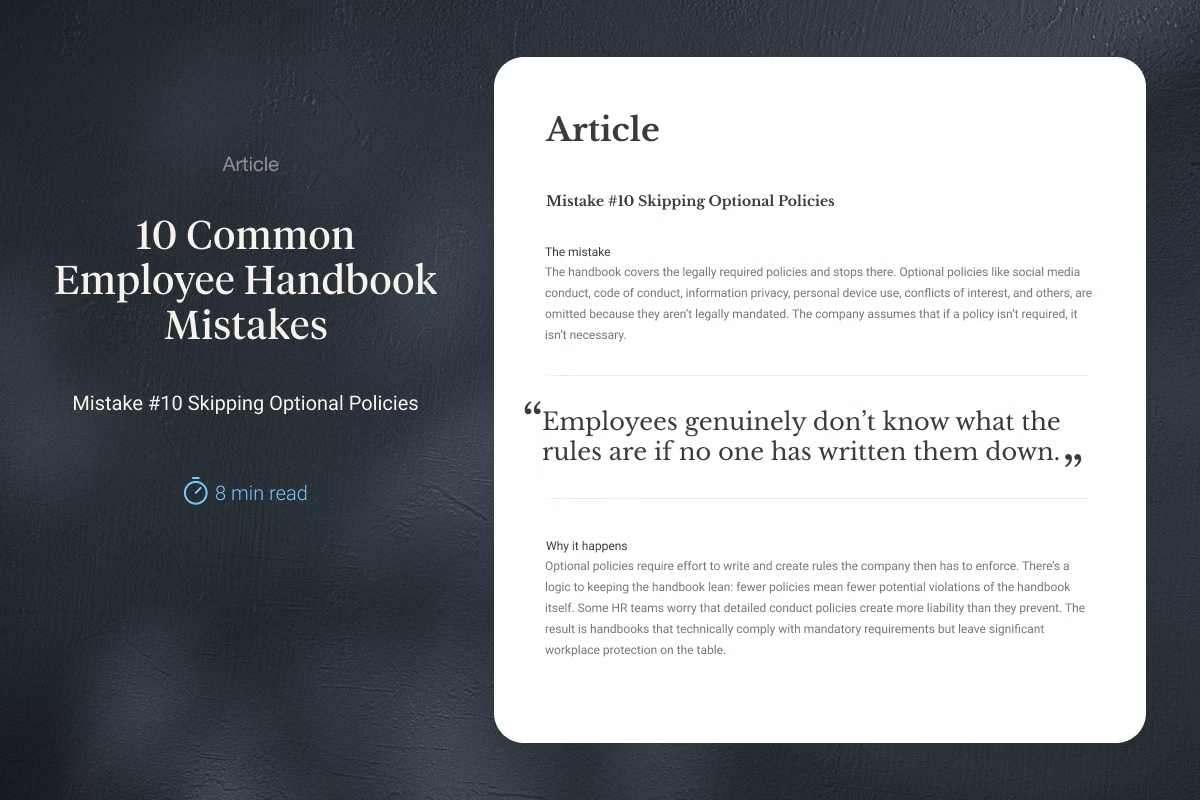
10 Common Employee Handbook Mistakes: #8 Weak or Non-Compliant Harassment Policies
A non-compliant harassment policy weakens every defense a company has when a claim is filed.
Your employee handbook is the foundation of your employment relationship. It communicates expectations, establishes legal protections, and documents the policies your company lives by. Done well, it protects your organization from the legal claims, disputes, and compliance failures that cost companies millions of dollars every year. Done poorly or not done at all, it creates the very exposure it was meant to prevent.
Most handbook mistakes aren’t obvious. They don’t look like mistakes. They look like a signed acknowledgment page, an annual review process, a thoughtfully downloaded template, or a conveniently short document that doesn’t burden employees with too much to read. The problem is that each of these common practices leaves companies legally exposed in ways that only surface when something goes wrong.
Here is the eighth of the ten most common employee handbook mistakes, what they are, why they happen, what they actually cost, and how to fix them.
Mistake #8: Weak or non-compliant harassment policies
The mistake
The handbook includes an anti-harassment policy that covers the federal basics: a general prohibition on harassment, a statement that complaints will be investigated, and a note that retaliation is prohibited. The company considers harassment covered. Several states would disagree.
Why it happens
Federal anti-harassment requirements are well understood and have been part of standard handbook practice for decades. What’s less understood is that a growing number of states have gone significantly beyond the federal baseline, requiring specific content elements, multiple reporting channels, mandatory training frequencies, and particular compliance procedure language that generic policies don’t include.
The real risk
New York requires harassment policies to include specific elements: a description of harassment with examples, the complaint process with multiple reporting channels, the investigation procedure, employee rights and remedies, and a reference to annual training. California requires biennial harassment prevention training and specific complaint procedures. Connecticut, Illinois, Maine, and others impose their own requirements. A federal-baseline harassment policy fails every one of these states.
The exposure here is compounded by the severity of harassment claims. Harassment litigation is among the most costly employment litigation a company can face. A non-compliant harassment policy, one that omits required reporting channels or fails to describe the complaint procedure as state law requires, weakens every defense a company has when a claim is filed.
The fix
Harassment policies need to be written to the requirements of each state where you employ people. For states with specific content mandates, generic language is not a compliant substitute. The policy must include every required element, in the form and with the specificity the state requires.
SecuraHR generates harassment policies that meet the specific requirements of each state, including New York’s mandatory content elements, California’s complaint procedure requirements, and the requirements of every other state that goes beyond the federal baseline. When states update their harassment requirements, which has happened regularly as legislatures have strengthened protections, SecuraHR updates the affected policies.
The common thread
These ten mistakes share a root cause: treating the employee handbook as a one-time administrative task rather than a living compliance document. Handbooks get written, distributed, and filed and then they sit unchanged while employment laws evolve, workforces expand into new states, and workplace conduct issues arise that no one thought to address in writing.
The companies that avoid these mistakes treat their handbooks the way they treat other compliance infrastructure: as something that requires the right foundation, continuous maintenance, a proper delivery process, and a complete record of who received what and when. That approach isn’t more complicated than what most companies are doing today. It’s just more deliberate and it pays for itself the first time it prevents a claim from succeeding.
How to build handbooks that don’t make these mistakes
SecuraHR generates attorney-drafted, state-specific employee handbooks for every state where your employees work, with integrated video presentations, policy-level acknowledgment tracking, a complete digital audit trail, and continuous legal monitoring that keeps every policy current as laws change.
Get started at www.securahr.com